

A New Building Regulation; The Risk of Overheating.
Glass, sunshine and heat – how does it work?
The sun emits electromagnetic radiation. The wavelength of electromagnetic radiation determines what it is – very short wavelengths are nasty gamma rays, and very long ones are radio waves. Between the extremes are X-rays, ultra-violet (UV), visible light, infrared, and microwaves.
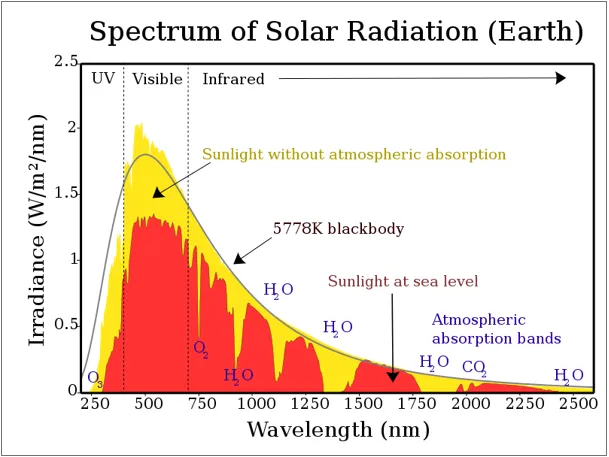
The sun’s radiation at sea level consists of a bit of UV, but then mostly visible light and infrared.
Credit: Nick84 [CC BY-SA 3.0], via Wikimedia Commons
The red part of the diagram above shows the wavelengths we get from the sun. The area of the red part represents the energy received, and about half of it is infrared, which is heat.
Glass lets in the shorter “near infrared” wavelengths, which dominate the solar infrared spectrum. When it hits an object inside the building, that object warms up and re-emits the heat at longer “far infrared” wavelengths,. Glass is opaque to far infrared, so it cannot escape and heat accumulates.
Once the infrared has passed through the glass, it is trapped and an internal blind has already lost half the battle. This is why you see external shutters on buildings in southern Europe, and the best Velux windows have external blinds.
Sunshine and glass – winter friend, summer foe
Glass can significantly reduce the heating demand in winter, but risks creating an air-conditioning demand in summer to deal with overheating. The current Part L of the building regulations tries to reduce this risk with a fairly crude method to try and prevent high risk designs getting through which will be retro-fitted with energy hungry air-conditioning.
A large south facing window is great on a sunny winter’s day. The sun is low and streams into the room heating everything up. A southeast to east or southwest to west window on a sultry sunny summer’s day is a scorcher. The summer sun is lower in the sky early and late in the day. South can still be a problem, but less so as the midday sun is very high in summer.
Part O
Summer overheating risk has been taken out of the new Part L and Approved Document O has been published to provide guidance on compliance with the brand new Part O of the building regulations which comes into force on 15 June 2022.
The regulation requires that summer overheating has been mitigated via passive means as far as possible, and mechanical cooling (air-conditioning) only used where the requirement cannot be met by using openings. Passive means of summer overheating mitigation is important as air-conditioning is not a desirable or financially efficient solution because of its energy use. There will be increased demand on the grid from transport and heating, so unnecessary pressure on supply will delay our transition to zero-carbon electricity. Also, if air-conditioning is designed in, it has to be compensated for through other energy efficiency measures (Part L).
It applies to new residential buildings only, and includes not only dwellings (flats and houses) but other residential buildings such as care homes and student accommodation (but not hotels). It covers England only.
For dwellings the whole building is assessed, but for other residential buildings individual rooms are assessed.
The Approved Document offers two methods to achieve compliance:
- A simplified method which means adhering to limits on glazing and takes account of orientation and geographic location (central London and parts of Manchester are considered high risk).
- Dynamic thermal modelling using CIBSE’s TM59 methodology with certain standardised limits on the temperatures and times of day/night that glazing and doors should be opened. This may offer increased design flexibility where fabric or external factors are not typical.
Alternative methods must be agreed in advance with the building control body.
There is a detailed design checklist to be completed and signed off by the designer, and provided to the building control body to show that compliance will be achieved. Then there is a declaration that the design has been followed, to be completed and signed by the builder and counter-signed by the building inspector.
There is a requirement to ensure the overheating mitigation strategy is usable by the occupants, and there is guidance on noise, pollution, security, protection from falling, and protection from entrapment.
And finally, there is a requirement to provide information to the building owner so that the overheating mitigation strategy can be used effectively. It is suggested that it can be included in a section of the Home User Guide that will be required under the new Part L.
ERS Consultants can assist yourself and your project with a Dynamic Thermal Modelling report and Modelling as required for Part O of the Building Regulations. Call us to discuss on 01865 378885 or email info@erscltd.co.uk.